


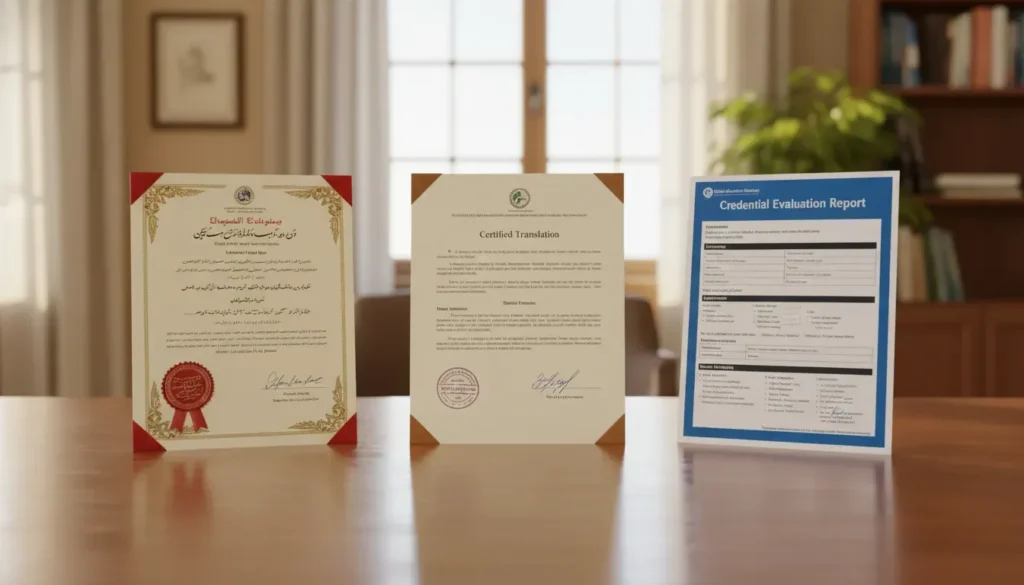
Applying to a U.S. school or for a job with your international degree? One of the biggest hurdles is getting your academic records accepted. You might think a simple translation is enough, or that you don’t need anything since your degree was taught in English. These assumptions can lead to frustrating delays or even rejections. For most records, you need both a certified translation and a credential evaluation. They work together to make your education understood, but they aren’t the same. Understanding the complete translation credential evaluation process is your key to a smooth application.
Start your evaluation and translation with IEE today and get results in as few as 3 business days.
This guide breaks down the difference between certified translation and credential evaluation, explains the specific situations where you need both, lists the documents that commonly require translation, and walks you through how International Education Evaluations (IEE) handles the entire process under one roof.
What Exactly Is a Certified Translation?
A certified translation is a word-for-word translation of an official document from its original language into English, accompanied by a signed statement from the translator or translation agency attesting to the accuracy and completeness of the translation. U.S. institutions, government agencies, and licensing boards require certified translations because they need assurance that the English version faithfully represents the original document.
Certified translations are not the same as informal or machine translations. A certified translation must be performed by a qualified human translator who signs a certificate of accuracy. This certificate typically states that the translation is a true and complete rendering of the original and that the translator is competent to perform the translation.
Common documents that require certified translation include:
- Diplomas and degree certificates
- Academic transcripts and mark sheets
- Course descriptions and syllabi
- Professional licenses and certifications
- Birth certificates and identity documents
- Letters of recommendation from academic institutions
IEE offers certified translation services in more than 50 languages, ensuring your documents meet the standards required by U.S. institutions.
Who Can Legally Translate Your Documents?
It’s one of the most common points of confusion for applicants: who is actually qualified to translate your official documents? When you’re dealing with U.S. Citizenship and Immigration Services (USCIS), the rules are very specific. Any official document you submit that is not in English must be accompanied by a full, word-for-word English translation. The surprising part is who can do it. According to USCIS guidelines, you don’t need to hire a state-certified or notarized professional. In fact, as Yale’s Office of International Students & Scholars clarifies, anyone who is fluent in both English and the original language can perform the translation. This means a trusted friend or colleague could technically do the job, but there’s a critical step they must follow to make it official.
Understanding USCIS Translation Requirements
For a translation to be considered valid by USCIS, it must come with a certification. This isn’t a formal certificate from an organization, but rather a signed statement from the person who did the translation. In this statement, the translator must attest that they are competent to translate from the foreign language into English and that the translation is complete and accurate to the best of their knowledge. The certification must also include the translator’s full name, signature, contact information, and the date of translation. Without this signed statement, your documents will likely be rejected, causing frustrating delays. This requirement is non-negotiable, regardless of whether you use a friend or a professional service.
While USCIS rules offer flexibility, most universities, employers, and professional licensing boards have stricter standards and prefer documents handled by a professional. This is where using a reputable service becomes a smart move. A professional agency provides a “certified translation,” which includes a formal Certificate of Translation Accuracy, guaranteeing it was done by a qualified translator and is a true reflection of the original. At IEE, we provide a certified translation service that meets the requirements of USCIS and other institutions. Choosing a professional service removes any doubt about compliance and ensures your application process is as smooth and fast as possible.
So, What Is a Credential Evaluation?
A credential evaluation is a professional assessment that compares your foreign academic credentials to their U.S. equivalents. An evaluator reviews your diplomas, transcripts, and other academic records to determine how your education measures up against American standards. The resulting evaluation report provides universities, employers, and government agencies with a recommendation of the closest comparable equivalency in the United States.
There are two main types of credential evaluation:
- Document evaluation: Provides a summary of your credentials, identifying each degree or diploma and its U.S. equivalent. This is often sufficient for employment and immigration purposes.
- Course-by-course evaluation: Offers a detailed breakdown of every course you completed, including grades, credit hours, and a calculated U.S. GPA. Most universities and licensing boards require this level of detail.
IEE provides both types through its evaluation services, with standard turnaround times of just 3 business days, which is significantly faster than most competitors in the industry.
Choosing a Credential Evaluation Service
Now that you know what a credential evaluation is, how do you pick the right service? It can feel a bit overwhelming, especially when so much is riding on the outcome. The good news is that you can make a confident choice by focusing on a few key factors. Understanding how the industry works, what professional memberships mean, and the importance of document verification will help you select a provider you can trust to handle your academic future with care. Let’s walk through what you need to look for to find a reliable partner for this important step.
Understanding the Industry: Private vs. Public
One of the first things to know is that in the United States, there isn’t a government agency that oversees or approves credential evaluation companies. These are all private businesses. This might sound a little like the Wild West, but don’t worry. To ensure quality and ethical standards, professional associations were formed to create a benchmark for excellence. These groups establish their own strict rules and best practices for their members. This structure simply means the responsibility falls on you to choose a reputable service, which is why knowing what to look for is so important for your success.
The Importance of Professional Memberships like NACES
Since the government doesn’t regulate evaluators, the most reliable indicator of quality is membership in a professional association. The most recognized of these is the National Association of Credential Evaluation Services (NACES®). NACES members are held to the highest standards of the profession and follow a strict code of conduct. For this reason, most U.S. universities, employers, and licensing boards will only accept an evaluation from a NACES member agency. Membership isn’t just a logo on a website; it involves a rigorous vetting process. As a proud NACES member, IEE provides evaluations that are widely recognized and trusted, giving you peace of mind that your report will meet institutional requirements.
What Is Document Verification?
Another critical part of a trustworthy evaluation is document verification. This is the process where the evaluation service confirms that your academic records are authentic and not fraudulent. The evaluator contacts the institution that issued your diploma or transcript to make sure the documents are real. This step is essential for maintaining the integrity of the entire evaluation system and is a non-negotiable for any credible service. It protects U.S. institutions from fraud, and it also protects you by validating your hard-earned credentials. At IEE, we include a thorough verification process to ensure every report we produce is accurate and defensible, giving everyone complete confidence in your background.
When Do You Need Both Translation and Credential Evaluation?
The short answer: whenever your academic documents are not in English. A credential evaluator cannot assess documents they cannot read. If your transcripts, diplomas, or other academic records were issued in a language other than English, you will need certified translations before the evaluation can proceed.
Here are the most common situations where applicants need both services:
Applying to a U.S. University
U.S. colleges and universities require credential evaluations as part of international student applications. If your academic records are in another language, the admissions office will need certified English translations alongside the evaluation report. Whether you are applying for an undergraduate program, a graduate degree, or transferring credits, both documents are typically required. Learn more about IEE’s higher education evaluation services.
For Your U.S. Immigration Application
USCIS and other immigration agencies frequently require credential evaluations for visa categories such as H-1B, EB-2, and EB-3. If your supporting academic documents are not in English, you must provide certified translations along with your evaluation report. Missing either document can result in a Request for Evidence (RFE) or outright denial of your application. IEE’s immigration evaluation services are accepted by USCIS and include support for expert opinion letters when needed.
Common Visas That May Require an Evaluation
Several employment-based visas have strict educational requirements, making a credential evaluation a critical part of your application. The H-1B visa, for example, is for professionals in specialty occupations that typically require a U.S. bachelor’s degree. Your evaluation report is the official document that proves your foreign degree meets this standard. Other common categories include the EB-2 visa, for those with advanced degrees, and the EB-3 visa for skilled workers and professionals. For each of these, USCIS needs to see that your academic background aligns with the visa’s specific criteria. An immigration evaluation provides that necessary verification, translating your hard-earned credentials into terms U.S. authorities can easily accept.
Securing a Professional License
State licensing boards for professions such as nursing, teaching, engineering, and accounting require credential evaluations to verify that your foreign education meets U.S. standards. If your original academic records are not in English, the licensing board will also require certified translations. This is especially important for internationally educated nurses who must meet state-specific board requirements.
A Note for Medical Doctors
If you’re a medical doctor who trained outside the U.S., you’re probably well-acquainted with the ECFMG certification needed for clinical roles and licensure. While that certificate is crucial for residency and sometimes for an H-1B visa, it’s important to understand its boundaries. For many immigration paths, especially green card applications, U.S. Citizenship and Immigration Services (USCIS) requires a separate credential evaluation to officially confirm your degree’s U.S. equivalency. The ECFMG certificate on its own isn’t enough for this specific step. And, just like with any other academic record, if your medical degree or transcripts are in a language other than English, you’ll need a certified translation before the evaluation can even start. This ensures every detail of your hard-earned education is accurately represented.
For Job and Employment Verification
Many U.S. employers request credential evaluations to confirm that a candidate’s foreign degree is equivalent to a specific U.S. qualification. When the original documents are in another language, employers or their HR departments will need certified translations to accompany the evaluation. See how IEE supports employment-related evaluations.
Enlisting in the U.S. Military
If you’re considering a career in the U.S. armed forces and hold a degree from another country, you’ll need to get your credentials evaluated. The U.S. military requires a credential evaluation to confirm that your foreign education meets its specific standards for enlistment. This step is essential for determining your eligibility and ensuring your academic background aligns with the role you’re pursuing. It’s the military’s way of making sure your hard-earned degree is properly recognized. Just like with other U.S. institutions, if your academic documents—like your diploma or transcripts—are in a language other than English, you will also need to provide a certified translation. The evaluation and translation work together to give recruiters a clear picture of your qualifications. IEE offers evaluations specifically for military enlistment, helping you meet all the necessary requirements to serve.
Even for Degrees from Canada or Taught in English
This is a question I hear all the time: “My degree was taught in English, do I still need an evaluation?” The answer is almost always yes. A credential evaluation isn’t just about language; it’s about comparing different educational systems. Even if your diploma and transcripts are in English, a U.S. institution or agency needs to know how your coursework, credits, and grading scale translate to American standards. It’s about ensuring educational equivalency, not just linguistic understanding. For example, even degrees from Canadian universities often require an evaluation. While the U.S. and Canadian systems have similarities, they aren’t identical. An evaluation report provides the official confirmation that your education is comparable. So, if your degree is from any institution outside the U.S.—regardless of the language of instruction—plan on needing a credential evaluation to make your academic journey a smooth one. For those with Canadian credentials, IEE even offers a specialized Canadian assessment.
What Documents Need Translation Before an Evaluation?
Not every document in your application will need translation. Here is a breakdown of the most commonly translated documents and when translation is necessary:
| Document Type | Translation Needed? | Notes |
|---|---|---|
| Degree certificate or diploma | Yes, if not in English | Required for all evaluation types |
| Academic transcripts, mark sheets or grade reports | Yes, if not in English | Essential for course-by-course evaluations |
| Course descriptions or syllabi | Sometimes | Required by some licensing boards and graduate programs |
| Letters of completion | Yes, if not in English | Used when official diplomas have not been issued yet |
Check the full list of required documents on IEE’s website to confirm exactly what you need based on your country and evaluation type.
How to Combine Your Translation and Credential Evaluation
One of the biggest advantages of working with IEE is that you can get both your certified translation and credential evaluation from a single provider. This eliminates the hassle of coordinating between separate translation and evaluation companies, reduces the chance of errors or mismatched documents, and speeds up the overall timeline.
Here is how the combined process works:
- Submit your documents: Upload your original academic records through IEE’s secure online portal. If your documents are not in English, indicate that you need translation services as part of your application.
- Translation is completed first: IEE’s team of professional translators creates certified English translations of each document. Every translation is reviewed for accuracy by a second translator before it is finalized.
- Evaluation proceeds immediately: Once the translations are complete, the evaluation team reviews your credentials and prepares your evaluation report. Because translation and evaluation happen within the same organization, there is no gap or delay between the two steps.
- Receive your completed report: Your evaluation report, along with your certified translations, is delivered electronically and by mail. Standard processing takes just 3 business days after all documents are received.
This streamlined process is especially valuable for applicants on tight deadlines, such as students facing university application cutoffs or professionals responding to job offers with time-sensitive start dates.
Avoid These Common Translation & Evaluation Mistakes
Applicants frequently run into problems when they do not understand the relationship between translation and evaluation. Here are the most common mistakes and how to avoid them:
- Submitting uncertified translations: A translation done by a friend, family member, or free online tool will not be accepted. It must be a certified translation with a signed accuracy statement.
- Assuming evaluation includes translation: Credential evaluation and translation are separate services. If your documents are not in English, you need to request translation in addition to your evaluation.
- Using different providers for translation and evaluation: While this is possible, it often introduces delays and compatibility issues. If the evaluation agency is not familiar with the translation format, they may request additional documentation.
- Waiting until the last minute: Translation and evaluation each take time. If you need both, plan ahead. IEE’s 3-day standard turnaround helps, but submitting early gives you a buffer for any unexpected issues.
- Sending partial documents: Make sure you send all required academic records, not just your diploma. Transcripts, mark sheets, and supplementary documents may all need translation and evaluation.
Ready to get started? Apply for your certified translation and credential evaluation with IEE now.
Mistake #1: Assuming All Institutions Have the Same Rules
It’s easy to think that once you have your documents in order, you’re good to go anywhere. But one of the most common slip-ups I see is assuming that every university, employer, or licensing board plays by the same set of rules. They don’t. Each institution has its own specific list of requirements, and they can vary wildly. For example, one university might be perfectly fine with you uploading your documents, while another might insist they receive them in a sealed envelope directly from your evaluation agency. That’s why it’s so important to do your homework. Before you even start your application, check the specific requirements with *both* the credential evaluation service you’re using and the institution where you’re sending the final report. This simple step can save you from major headaches and delays down the road.
Checking for Special Requirements like “Wet Ink” Signatures
Sometimes, the requirements can get surprisingly specific. Have you ever heard of a “wet ink” signature? It’s a rule some institutions have, meaning they require a physical, handwritten signature on a document, not an electronic one. This is a perfect example of a small detail that can derail your application if you miss it. Other special rules might include how your translations must be submitted or specific forms that need to be filled out by the evaluator. The lesson here is to read the fine print on every application. Never assume you know what they need. Always verify the submission guidelines directly with the institution to make sure you’re not missing a crucial step that could hold up your entire process.
Mistake #2: Paying to Evaluate Every Single Credential
When you’re trying to present the most complete picture of your academic history, your first instinct might be to get every single certificate and diploma you’ve ever earned evaluated. While that thoroughness is admirable, it’s usually unnecessary and can get expensive fast. In most cases, you only need to evaluate your highest degree that is relevant to your goal. For example, if you’re applying for a job, you typically only need an evaluation for the degree that qualifies you for that position. Similarly, for U.S. immigration purposes, USCIS often just requires an evaluation of your highest completed degree. Evaluating credentials you don’t need to can be a waste of both time and money, so it’s always best to confirm which documents are truly necessary. You can review our transparent pricing to see how focusing on only the essential documents can make the process more affordable.
Your Questions About the Process, Answered
International Education Evaluations has been helping applicants navigate the credential evaluation process since 1981. As a member of the National Association of Credential Evaluation Services (NACES), IEE’s reports are widely accepted by universities, employers, licensing boards, and USCIS across the United States.
Key reasons applicants choose IEE:
- One provider for both services: Get your certified translation and credential evaluation from a single trusted source, saving time and reducing the risk of errors.
- 3-day standard turnaround: IEE delivers results faster than most competitors, with expedited options available when you need next-day or same-day processing.
- NACES member: IEE’s evaluations carry the credibility of NACES membership, which is recognized by institutions and agencies nationwide.
- 50+ languages supported: No matter where you studied, IEE can translate your documents into English with certified accuracy.
- 24/7 customer support: IEE offers around-the-clock support via chat, phone, and email, so you can get help whenever you need it.
- Transparent pricing: Evaluation reports start at $95, and all pricing is listed clearly on the website.
Frequently Asked Questions
Do I always need a certified translation for credential evaluation?
You need a certified translation only if your academic documents are not in English. If your transcripts and diplomas were issued by the awarding institution already in English, you can proceed directly with the credential evaluation. If any documents are in another language, certified English translations are required before the evaluation can be completed.
Can I get my translation and evaluation from the same provider?
Yes. IEE offers both certified translation and credential evaluation services, which means you can submit your documents once and receive both services without coordinating between separate companies. This approach is faster and reduces the chance of errors.
How long does the translation and evaluation process take?
IEE’s standard turnaround is 3 business days for evaluation after all required documents, including translations, are received. If you need both translation and evaluation, the total timeline depends on the volume and complexity of your documents. Expedited processing options are also available for urgent deadlines.
What languages does IEE translate?
IEE provides certified translation services in more than 50 languages, covering the vast majority of countries and education systems worldwide.
Is a certified translation the same as a notarized translation?
No. A certified translation includes a signed statement from the translator or agency attesting to the accuracy of the translation. A notarized translation adds a notary public’s seal, which verifies the identity of the signer but does not vouch for translation quality. Most U.S. institutions accept certified translations without notarization, but check with your specific recipient to confirm their requirements.
Will USCIS accept IEE’s translations and evaluations?
Yes. IEE is a NACES member, and its evaluation reports are accepted by USCIS for immigration applications including H-1B, EB-2, EB-3, and other visa categories. IEE’s certified translations also meet USCIS requirements for supporting documentation.
Who is responsible for paying for the evaluation?
In nearly all cases, you are responsible for arranging and paying for your credential evaluation. It’s helpful to think of it as an investment in your future. Whether you need it for a university application, a job, or an immigration petition, the cost falls to you, the applicant. The good news is that the final report belongs to you. This means you can use the same evaluation for multiple applications, making it a valuable and reusable asset for your academic or professional journey. To help you plan, reputable agencies provide clear and transparent pricing so you can budget for this expense without any surprises. Your employer or university will not typically cover this fee, so it’s best to prepare for it as part of your application costs.
What should be in my final evaluation report?
A comprehensive evaluation report should leave no room for interpretation. At a minimum, it must clearly state the U.S. equivalency of your degree and your specific field of study. For example, it might conclude that your credential is “equivalent to a U.S. bachelor’s degree in mechanical engineering.” If you order a course-by-course evaluation, it will also include a list of your subjects, U.S. equivalent grades, credit hours, and a calculated GPA. The report should also contain information about the evaluation agency’s credentials, which confirms its authority to make the assessment. A report from a trusted NACES member like IEE ensures that universities, licensing boards, and employers receive a clear and credible recommendation they can rely on.
Ready to Get Started?
If you studied outside the United States and your academic records are not in English, you almost certainly need both a certified translation and a credential evaluation. Getting both from a single provider like IEE saves you time, reduces the chance of errors, and ensures your documents are processed quickly and accurately.
Whether you are applying to a university, pursuing professional licensure, seeking employment, or navigating the immigration process, IEE has the expertise and speed to help you move forward with confidence. With 44+ years of experience, NACES membership, and 3-day standard turnaround, IEE makes the process straightforward.
Start your certified translation and credential evaluation with IEE today.
Key Takeaways
- Translation and Evaluation Are Two Different Steps: A certified translation makes your documents readable in English, while a credential evaluation assesses how your education compares to U.S. standards. If your academic records are not in English, you will need both for your application to be successful.
- Prioritize NACES Membership for Evaluations: The U.S. government doesn’t regulate credential evaluators, so membership in an association like NACES is your best sign of quality. Most institutions require reports from NACES members, ensuring your evaluation is recognized and trusted.
- Always Verify Institutional Requirements First: Every university, licensing board, and employer has its own specific rules for submitting documents. Before you apply, check their guidelines directly to avoid delays caused by missing a small but critical detail, like how your report must be delivered.