


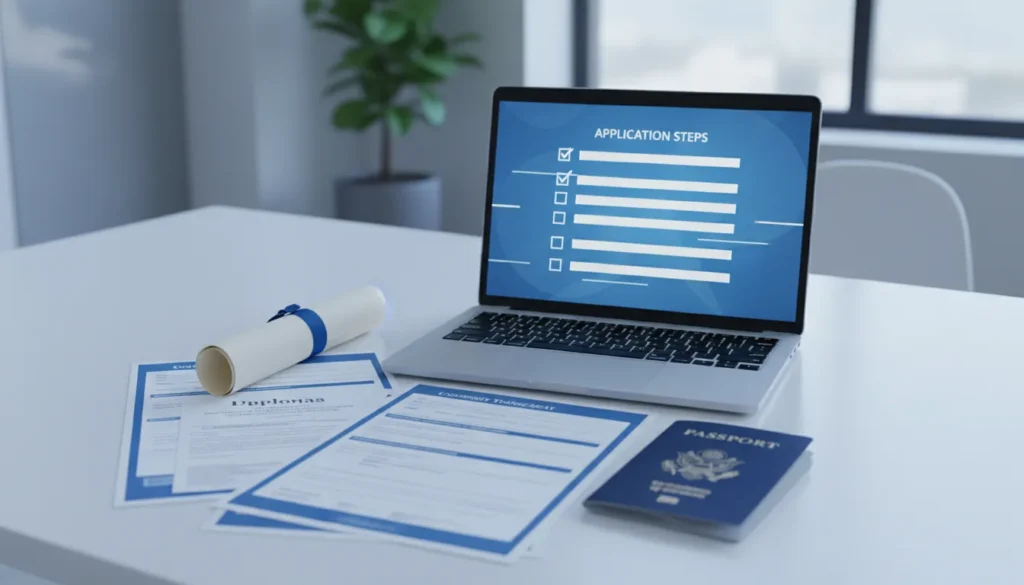
If you earned your degree outside the United States and are preparing an H-1B petition, a credential evaluation for H-1B visa filing can help show how your education compares to a U.S. degree in the specialty occupation. The right evaluation gives the employer, attorney, and petition team a clear academic equivalency report before filing deadlines create pressure.

Need an immigration credential evaluation on a tight timeline? Start with IEE Immigration Services for a NACES member evaluation with standard 3-business-day turnaround.
H-1B petitions often move quickly after registration selection, employer sponsorship, or a request for evidence. If the beneficiary’s education is international, the petition team may need a report that explains the foreign credential, the institution, the program level, and the U.S. educational equivalent. Preparing that report early can reduce last-minute document issues and give your attorney more time to review the petition package.
What is a credential evaluation for H-1B visa filing?
A credential evaluation is a written report that compares academic records from another country to U.S. educational standards. For an H-1B petition, the evaluation helps document whether the beneficiary’s foreign degree is equivalent to the U.S. degree normally required for the specialty occupation.
USCIS explains that, in cases involving foreign degrees, officers may consider a credential evaluation from an independent credentials evaluator when it provides a credible, logical, and well-documented basis for the equivalency. USCIS also makes the final decision on the petition, so an evaluation is supporting evidence, not a guarantee of approval.
For many applicants, the report answers practical questions such as:
- What is the U.S. equivalent of the foreign degree or diploma?
- Was the institution recognized or accredited in its country?
- How does the program level compare to U.S. higher education?
- Is a course-by-course review needed, or is a degree equivalency enough?
- Does the petition also need translation or expert opinion support?
When is an H-1B credential evaluation needed?
An H-1B credential evaluation is most commonly needed when the beneficiary earned a degree outside the United States and the petition relies on that degree to meet the specialty occupation requirement. USCIS states that an H-1B specialty occupation generally requires theoretical and practical application of highly specialized knowledge and at least a bachelor’s or higher degree in a directly related specific specialty, or its equivalent.
You should discuss the need for an evaluation with your immigration attorney, but these scenarios often trigger the need for one:
- The degree was issued outside the United States. A U.S. equivalency report can explain the credential in terms USCIS and the petition team can understand.
- The field of study must be connected to the H-1B role. The report can document the academic program, level, and coursework that support the specialty occupation argument.
- The degree name is unfamiliar in the United States. International credential names, program lengths, and grading systems vary by country.
- The petition has a tight filing window. Ordering early gives time to resolve missing documents, translation needs, or report type questions.
- The case may receive close review. A clear evaluation can help the attorney build a more complete evidentiary record.
IEE’s immigration credential evaluation services are commonly used for temporary worker categories, including H-1B, L-1B, TN, and E-3, as well as immigrant categories such as EB-1, EB-2, and EB-3.
Before you order, it helps to understand how this article differs from IEE’s existing H-1B content. IEE already has a broader strategic guide on early H-1B credential evaluations and RFEs. This article serves a different search intent: it is a practical ordering guide for applicants and petition teams who need to choose an IEE report type, gather documents, and plan around the 3-business-day evaluation timeline. The focus is operational rather than policy-heavy, with direct links to the immigration, evaluation service, documentation, and pricing pages.
Which IEE report type fits your H-1B situation?
The right report depends on what the petition needs to prove. Some H-1B cases only need a degree equivalency. Others benefit from a more detailed course-by-course analysis, especially when the relationship between the degree and the job duties needs to be documented carefully.
| H-1B situation | IEE report to consider | Why it may fit |
|---|---|---|
| You need to show the U.S. equivalent of a completed foreign degree. | Document Report | Provides core degree equivalency, institution information, and credential recognition. |
| The petition team wants GPA included with the degree equivalency. | Document + GPA Report | Adds GPA calculation to the basic credential evaluation. |
| The attorney wants detailed coursework reviewed for specialty relevance. | Course Report | Includes course grade and credit conversion, GPA calculation, and coursework sorted chronologically. |
| The case involves advanced education, multiple levels, or a more complex academic history. | Divisional Course Report | Organizes coursework by level, which may help when graduate-level study needs to be shown clearly. |
| The case may need analysis beyond a standard academic evaluation. | Expert Opinion Letter | Available for certain employment-based cases when initiated through the applicant’s attorney. |
IEE’s evaluation service chart is a helpful starting point because it compares what each report includes. If you are not sure which report your petition needs, ask your attorney before ordering. The attorney’s strategy should guide the report type, especially when the H-1B role, degree field, and job duties must align closely.
Document Report vs. Course Report for H-1B petitions
A Document Report is often appropriate when the petition needs a straightforward statement of the U.S. degree equivalency. It identifies key academic credentials and provides the U.S. educational comparison. For many applicants with a completed foreign degree that clearly matches the role, this may be enough for the petition team’s needs.
A Course Report goes deeper. It reviews coursework, grades, credits, and GPA. This can be useful when the attorney wants to show more detail about what the beneficiary studied, especially if the degree title does not make the specialty obvious or the program structure differs from a typical U.S. bachelor’s or master’s degree.
Have your attorney confirm the right report before you order. Then review IEE pricing so you can plan the evaluation cost and timeline before the filing window tightens.
What documents should you prepare?
Document requirements vary by country and credential type, so the safest first step is to check IEE’s documentation requirements before submitting your order. For immigration credential evaluations, IEE accepts legible scanned copies of required documents and does not require original documents for credential evaluations used for immigration purposes.
In general, applicants should prepare:
- Degree certificate or diploma. This shows the credential awarded and date of completion.
- Academic transcripts or mark sheets. These show courses, grades, credits, terms, and program details.
- English translations, if needed. Documents not issued in English may need certified translation support.
- Clear scans. Blurry, cropped, or incomplete files can slow down review.
- Name change documentation, if applicable. If your academic records and passport use different names, ask your attorney what supporting documents to include.
- Attorney instructions. If the law firm requests a specific report type, delivery format, or recipient, gather those details before ordering.
If your documents are not in English, IEE also offers immigration translation services. Every IEE translation includes a sworn translator statement consistent with USCIS requirements, and translation pricing is listed at $60 per page of up to 250 words on IEE’s immigration page.
How long does an H-1B credential evaluation take?
IEE’s standard turnaround for academic evaluation reports is 3 business days. This is especially important for H-1B cases because petition teams often work against filing deadlines, employer timelines, and attorney review schedules.
A 3-business-day turnaround does not mean applicants should wait until the final week to order. Build in time for document collection, translation if needed, attorney review, delivery to the petition team, and any correction requests. A practical timeline might look like this:
- Day 1: Confirm report type with the attorney and gather documents.
- Day 2: Submit legible scans through the IEE application process.
- Days 3 to 5: IEE completes the standard evaluation, assuming required documents are complete.
- After delivery: Attorney reviews the report and adds it to the petition package.
IEE also offers rush processing options for urgent cases, including 2-day rush service and same-day service when documents are received by the stated cutoff. Rush service should still be coordinated with your attorney because the fastest evaluation cannot fix missing, illegible, or inconsistent academic records.
How IEE helps reduce H-1B filing delays
H-1B delays often happen when education documents are incomplete, report types are mismatched to the petition strategy, or the evaluation is requested too late. IEE is built to reduce those risks with fast standard processing, clear document guidance, and support for immigration use cases.
Key advantages include:
- NACES membership. IEE is a member of the National Association of Credential Evaluation Services, and its evaluations are trusted by USCIS and other U.S. government agencies.
- 3-business-day standard turnaround. Fast standard processing helps petition teams avoid unnecessary waiting.
- Immigration-focused services. IEE supports H-1B, L-1B, TN, E-3, EB-1, EB-2, and EB-3 use cases.
- Scanned document acceptance for immigration evaluations. Applicants can submit legible scanned copies instead of original documents for immigration credential evaluations.
- 24/7 support. IEE provides customer support by chat, phone, and email, which is valuable when deadlines are close.
- Transparent pricing. Report pricing is published, making it easier to plan costs before ordering.
Ready to prepare your H-1B education documentation? Request an immigration evaluation with IEE and give your petition team the report they need before deadlines create delays.
Common questions about H-1B credential evaluations
Does every H-1B applicant need a credential evaluation?
No. If the beneficiary earned a U.S. degree that satisfies the specialty occupation requirement, a foreign credential evaluation may not be needed. If the petition relies on a foreign degree or a combination of international education and experience, ask the immigration attorney whether an evaluation is required.
Will a credential evaluation guarantee H-1B approval?
No. USCIS makes the final decision on the petition. A credential evaluation is supporting evidence that can help explain the beneficiary’s education, but it does not guarantee approval.
Can IEE evaluate scanned documents for immigration purposes?
Yes. For credential evaluations used for immigration purposes, IEE accepts legible scanned copies of required documents and does not require original documents.
Should I choose a Document Report or a Course Report?
Choose based on the attorney’s petition strategy. A Document Report may be enough for a basic degree equivalency. A Course Report may be better when detailed coursework, GPA, credit conversion, or field-of-study alignment matters to the case.
Can IEE provide expert opinion letters for H-1B cases?
IEE offers expert opinion letter services for certain employment-based immigration cases. If you are interested in this service, IEE asks that your attorney reach out to initiate the process.
Final checklist before you order
Before submitting your H-1B credential evaluation request, confirm these items:
- Your attorney has confirmed the report type.
- You have reviewed the country-specific documentation requirements.
- Your scans are complete, legible, and uncropped.
- You have translations ready or have planned translation service if needed.
- You have allowed time for IEE’s 3-business-day standard turnaround plus attorney review.
- You have selected the correct recipient and delivery instructions for the petition team.
A strong credential evaluation gives your H-1B petition team clear education evidence before the filing deadline. By choosing the right IEE report, preparing complete documents, and starting early, you can help your employer and attorney avoid avoidable delays in the petition process.