


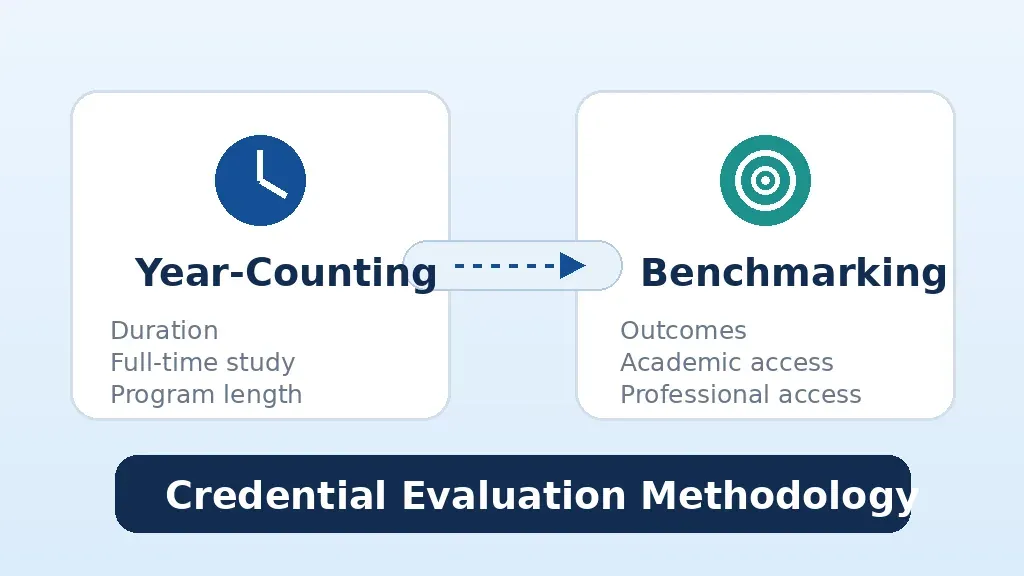
Year-Counting and Benchmarking: IEE’s Methodologies
If educated outside of the United States, a credential evaluation may be necessary to reach goals in education, employment, licensure or immigration. While a report must often be submitted, the findings of and conclusions on the report are just as important. Credential evaluators apply a specific mindset or methodology to the interpretation of your credentials, which can significantly change how an international qualification is understood in the United States. While two different students may have completed rigorous programs abroad, the way an evaluator treats the achievement can affect the final equivalency. Due to this, International Education Evaluations (IEE) openly explains its use of year-counting and benchmarking methodologies; that way, applicants and receiving organizations can know and understand how the credentials on the evaluation were approached.
For easy reference, feel free to review IEE’s evaluation services now so you can choose the report that fits your immediate needs. Or, keep reading to learn about our methodologies employed to generate equivalencies and support recognition for international students and degree holders.
What Credential Evaluation Methodology Means
Evaluation methodology is the approach an evaluator uses to determine a credential’s equivalency in another country. It is not simply a mechanical conversion table or a translation application. While each credential has a number of factors taken into consideration to create an equivalency, the methodology used may place more weight on one factor over another. Factors accounted for include country of education, admission requirement, program duration, general amount of contact hours or credits, academic progression, professional access after conferral and the evaluation’s purpose.
IEE’s evaluation guidelines page includes provisions about how to reach an equivalency. All evaluations are based on the judgments of trained international credential analysts with access to a high amount of physical and electronic research resources. IEE is a member of the National Association of Credential Evaluation Services (NACES), and also has affiliations with NAFSA, AACRAO, and TAICEP, which are all organizations devoted to international education, credential evaluation and higher education. IEE’s evaluations comply with modern practices and industry standards in international and comparative education.
While staying active in the industry and conforming to its ethical and professional standards, IEE sets itself apart in the industry in many ways, from low processing times to transparent fees. Another area of distinction is methodology, with two unique types presented. Methodology matters because international education systems are not all the same. Some systems feature 10 or 11 years of elementary and secondary education. Others may feature a phase between secondary education and university education. Moreover, the first undergraduate degree in many systems lasts 3 years instead of 4. A fair evaluation has to understand what a credential actually represents in its home system and how it can function for the applicant’s next step elsewhere.
Quick Answer: Year-counting vs. Benchmarking
The two methodologies used at IEE are year-counting and benchmarking. In short, year-counting emphasizes the number of years of full-time study, while benchmarking underscores the academic and professional outcomes, among other things, that a credential provides. IEE uses both approaches in evaluations, but it is contingent on the report’s purpose, the receiving organization’s requirements and the country of education.
In practice, the two methods overlap. A benchmarked evaluation still does some counting, considering things like duration, contact hours and credits. A year-count evaluation makes reference to benchmarks, especially at the secondary level or in matters of professional education. The difference lies in the weight of specific factors.
Year-counting: A Duration-Focused Approach
Year-counting is the more traditional U.S. approach to credential evaluation. It prioritizes years of full-time study as the foundation for comparing international qualifications. As an operating premise, it treats an academic year or term of full-time study in one country as broadly proportionate to an academic year or term of full-time study in another country.
This approach applies significant weight to:
- Entrance requirements for the program
- Official program duration
- Years or terms of full-time academic study
- The sequence from secondary to postsecondary education
- The methodology preference of the receiving organization
Year-counting can be useful when a receiving organization has strict rules tied to duration. For example, a licensing board, immigration adjudicator, or university admissions committee may require a specific number of postsecondary years before issuing a license, visa or slot. In those cases, a duration-focused equivalency can help the receiving organization apply its own requirements consistently with the assurance that its needs and values are considered in the evaluations. In practice, year-counting is frequently the preferred method for organizations in sectors related to engineering and nursing.
When IEE Uses Year-counting
As explained in IEE’s guidelines, year-counting is utilized on reports for immigration, military and licensure purposes, as duration remains a critical aspect for these recipients. Furthermore, the year-count methodology is used on evaluations created for specific colleges and universities that have opted out of benchmarked equivalencies, as they prefer determinations and credit conversions to be based on the program duration as defined by years or academic terms. Lastly, divisional education reports use year-counting for postsecondary credentials, as the traditional classification of lower- and upper-division courses is based on the counting of years or academic terms.
Benchmarking: An Outcome-Focused Approach
Benchmarking is a contextual approach to credential evaluation. It prioritizes academic and professional access, curriculum rigor, contact hours, and learning outcomes. Instead of relying primarily on the number of years printed in a program description, benchmarking asks what the credential allows the graduate to do in the home country and how that compares with outcomes in the United States.
A benchmarking approach may consider:
- Whether the credential gives access to graduate or even doctoral-level study
- Whether the credential gives access to regulated or professional employment
- How specialized or complex the curriculum is
- How much structured learning the program includes through contact/instructional hours or raw credit count
- How the credential is understood by institutions, employers, and regulators in the country of education
- Whether program outcomes are commensurate with outcomes from comparable U.S. programs
Additionally, a country or region may have a qualifications framework that formally defines learning outcomes at each level of education. Evaluators reference these to get a sense of what competencies and access privileges are associated with the credential.
Benchmarking is important because the simple amount of years alone does not always capture the essence of the program. A three-year undergraduate degree may follow a secondary-level credential, include concentrated academic achievement, or provide direct access to graduate study and professional opportunities. Plus, in many instances, a three-year undergraduate degree actually contains more instructional hours or academic experience within those 3 years than a four-year program in the same subject in the U.S. A longer duration (in years or academic terms) may not necessarily produce the same rigor, subject-matter expertise, or access to subsequent academic levels. Therefore, IEE’s benchmarking methodology gives evaluators an opportunity to elevate the equivalency to a level that may actually be more reflective of the program’s scope, rather than merely copying the amount of years taken to determine the equivalency.
When IEE Uses Benchmarking
For many education and employment reports, IEE uses the benchmark methodology, indicating that academic and professional access, curriculum rigor, and contact hours can be used as central determining factors in the recommendation of an equivalency. IEE’s guidelines state that Document Reports, Document+GPA Reports, and Course Reports use benchmarking by default; this is called the “standard” approach. However, as previously stated, receiving institutions may opt out by requesting year-count evaluations exclusively.
Benchmarking can be especially helpful for colleges, universities, and employers who want to understand whether an applicant is prepared for a certain academic or professional level. It may also more easily confirm that a prospective employee or student fulfills organizational criteria for entry. IEE believes this approach vouches for credential holders successfully, which supports global learner mobility and increases opportunity while remaining grounded in evidence-based analysis. Although the structure of an education system may be different than the United States’ model, it can actually produce equal or possibly greater results.
Start an education-purposed evaluation if you are trying to get admitted to a higher educational institution, wish to pursue graduate or doctoral study, or even plan to claim credit for transfer or exemption.
How the Two Methods Compare
| Methodology | Primary Focus | Evaluation Purpose | Key Question |
|---|---|---|---|
| Year-counting | Years or terms of full-time study, entrance criteria | Immigration, licensure, military, and education (for institutions requiring duration-based equivalencies) | How much full-time study was completed? |
| Benchmarking | Academic and/or professional access, curriculum rigor, contact hours, level of study | Standard education and employment reports | What does the credential prepare the graduate to access or do? |
The methodology utilized depends on two main considerations: the purpose of the evaluation and the recipient institution. A graduate admissions office may care deeply about whether the credential provides access to graduate study in the home country. A licensing board may need a duration-based analysis because its regulations demand it. An employer may want to understand whether a candidate’s international degree represents a qualification comparable to a U.S. credential, which will help them determine if the candidate meets the minimum educational requirements for the job.
Why Receiving Organization Requirements Matter
It’s important to note that a credential evaluation is advisory and non-binding. A credential evaluation firm provides an educational analysis, but each institution, agency, employer, or licensing board makes its own decision about how to apply the report to a candidate. Meanwhile, IEE has developed close relationships with partners in various sectors, and has heard their wishes, needs, ideas and concerns. In an attempt to keep communication open, be transparent and serve clients of all kinds, IEE presents recipient organizations with the right to request a specific preferred methodology. Therefore, a receiving organization’s requirements are central to choosing the right report, and by extension, the methodology.
Before ordering an evaluation, applicants should generally ask the following:
- Does the institution require an evaluation from a member of NACES?
- Does it require a Document Report, a Course Report, a Licensure Report, or some other format?
- Does the recipient require year-counting, or can it accept benchmarking?
- Does it need specific information on the report, like credit conversions, grades, GPA, or subject categorization?
- Does it require official documents sent to IEE directly from the awarding institution?
IEE’s FAQs page and guidelines are useful starting points, but the receiving organization’s instructions should be checked as well. Still, the results of the report cannot be guaranteed, as each report has its own story. Methodology is a critical part of credential evaluation, and in the case of IEE’s reports, the recipient of your report may play in a role in the methodology employed and the final equivalency determination.
Why Evaluator Expertise Matters
Credential evaluation methodology is only as reliable as the evaluator applying it. International credentials can involve different grading scales, credit formats, qualification frameworks, oversight authorities, institution types, and program structures, among other things. A trained evaluator understands how to interpret these factors in order to produce an equivalency for your credential.
Evaluator expertise helps answer various questions about a credential, including:
- Is the awarding institution accredited or recognized by the country’s authorities?
- What level of education does the credential represent?
- What prior study was required for admission?
- What does the credential allow the graduate to do next?
- How should credits, grades, or contact hours be interpreted?
- Is the documentation sufficient to construct a proper report and analysis?
Comparative education is extremely nuanced and can be complex. With respect to methodology, a simple face value conversion can miss elements of the credential’s substance. IEE’s analysts use training on education systems and internal policies, research resources, experience and professional discretion to ultimately make these critical determinations.
Examples of Methodology in Evaluation Scenarios
Higher Education Admissions
An applicant may need an evaluation to be admitted to an undergraduate, graduate or doctoral-level program. For many education reports, benchmarking can help show academic level, qualification and readiness. It ultimately can unlock many opportunities for students educated in countries that don’t follow a four-year undergraduate degree structure like the U.S. However, if this approach creates an issue for a receiving institution that prefers to use year-counting, IEE is able to accommodate by way of the year-counting methodology.
Employment
Employers naturally want to understand the value of a candidate’s international credentials in order to attract the best talent. However, they often require students to have a four-year undergraduate degree or its equivalent before an offer is made. Benchmarking may help, as it can account for level of study, professional/academic access, and outcomes rather than simply program length. This also supports fair, holistic consideration of qualified candidates from different education systems.
Immigration
Immigration-purposed evaluations often require a duration-focused approach. IEE’s guidelines indicate that immigration reports exclusively use year-counting for postsecondary credentials while stating the educational equivalency of the foreign credential.
Browse IEE’s immigration evaluation support page for more details about reports headed to USCIS.
Professional Licensure
Licensing boards often have detailed rules about eligibility, including education required in order to receive a license; these rules may relate to academic level, credit amount, coursework undertaken, subject categories, professional preparation, and minimum duration of the credential. IEE’s licensure reports use year-counting methodology for postsecondary credentials. In addition to credit conversion, grade conversion and a GPA calculation, the reports also organize the coursework into subject categories, which can be helpful for boards and agencies as they adjudicate. IEE also offers specialized licensure reports meant for accounting, teaching, and nursing licensure.
Learn specifically about IEE’s nursing evaluations if you are pursuing nursing education or licensure in the United States.
What Applicants Can Do Before Ordering
You do not need to become a credential evaluation expert before ordering a report, but a few steps can prevent delays or mismatches.
- Confirm the purpose. Know whether the report is for education, employment, immigration, military, professional licensure, Canadian assessment, nursing, or something else.
- Ask the receiving organization what it accepts. Confirm your desired institution’s preferred report type, delivery method, and even if it has a favored methodology.
- Review IEE’s guidelines. The guidelines page explains report types, document requirements, and notes on methodology.
- Gather complete documents. Official transcripts, diplomas, certificates, translations, or verification materials may be needed depending on the report and your country of education.
- Choose the report that matches the requirement. A Course Report differs from a Document Report. A Licensure Report differs from an Education Report. Be sure to double-check both the type of report and purpose of the report.
If you are unsure, IEE can help you identify the evaluation purpose and product that aligns with your goal. Choosing the right report at the beginning is easier than revising one perhaps after it’s too late.
FAQs about Credential Evaluation Methodology
Is benchmarking better than year-counting?
Not always. Benchmarking and year-counting address different needs. Benchmarking can better capture outcomes and access, while year-counting may be necessary when a receiving organization has duration-based requirements. The right methodology depends on both the report purpose and recipient policy.
Does benchmarking mean every three-year degree equals a U.S. bachelor’s degree?
No. Benchmarking is not automatically applied just because a degree is three years long. While IEE is continuously refining, there are certain criteria that make a country of education and its three-year undergraduate degree eligible for benchmarking. It requires analysis of the country’s education system, the national qualifications framework, program level, entry requirements, academic rigor, access after graduation, number of contact or instructional hours and even type of documentation. Some three-year credentials may qualify for benchmarking, while others may not.
Can a university request year-counting instead of benchmarking?
Yes. IEE’s guidelines state that higher education institutions may opt out of benchmarked equivalencies and request year-counting evaluations exclusively. Applicants should investigate the institution’s requirements and policies before moving forward.
Will the evaluation report say which methodology was used?
Yes. The methodology appears at the top of the evaluation. There is further context provided in the statement of evaluation at the end of the report. IEE has emphasized openness around methodology, from mentioning methodology in its guidelines to publishing a whole white paper all about the benchmarking methodology. IEE wishes to be transparent with all stakeholders about how it reaches its conclusions.
Why is IEE’s NACES membership relevant?
NACES membership is widely recognized by institutions, agencies, and employers that receive credential evaluations. It give a sense of credibility and legitimacy to the evaluation. IEE has been a member of NACES since 2018.
The Bottom Line
Credential evaluation methodology helps turn an international education record into terms easily understood for U.S. educational institutions, employers, immigration authorities, and licensing boards. Year-counting provides a duration-focused comparison when policy requires it. Benchmarking provides a contextual comparison that weighs academic and professional access, contact hours, and outcomes before reaching a conclusion.
IEE uses both methods because different goals sometimes require different approaches. The fairest evaluation is not the one that forces every credential into the same mold. It is the one that applies the right methodology, uses expert judgment, and above all, serves the individual being evaluated and the organization receiving the evaluation.
Choose your IEE evaluation service or read the evaluation guidelines to find the report that best fits your next step.