


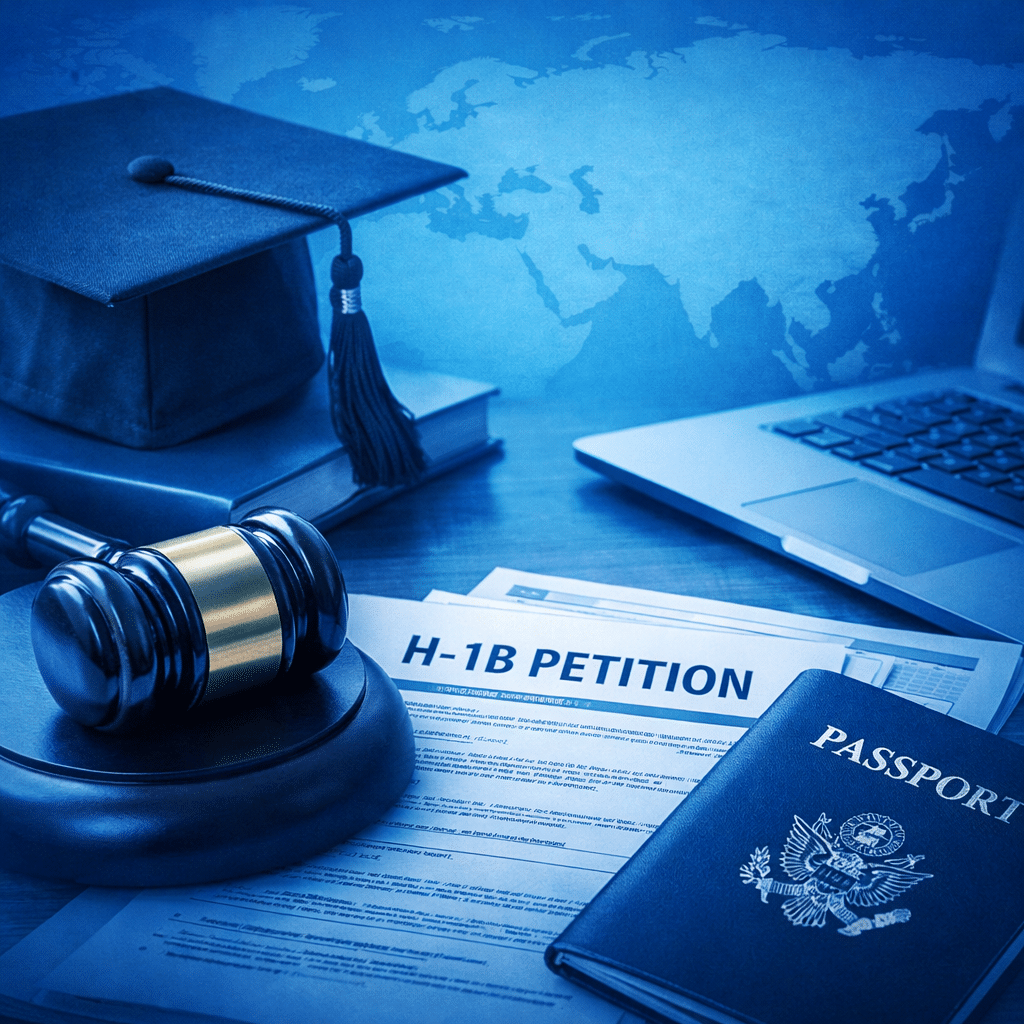
The ground is always shifting under H-1B petitions. USCIS policies change, scrutiny intensifies, and adjudication standards evolve. In this environment, a strong H-1B credential evaluation and a compelling expert opinion letter are no longer just administrative afterthoughts. They are essential strategic tools that can determine whether a petition is approved, delayed, or denied. Preparing these materials early gives attorneys, employers, and beneficiaries the clarity and confidence to move forward, turning uncertainty into a well-prepared case.
Why the H-1B Landscape Is More Unstable Than Ever
One of the only constants in H-1B petitions is change. Whether you are an attorney, employer, or an applicant, you are likely aware that political climates shift, the policies and adjudication standards of United States Citizenship and Immigration Services (USCIS) evolve, and filing requirements can change with little warning. This volatility creates real risk, especially when issues related to foreign degree and credential evaluation are left until the last minute. One of the most effective ways to manage that risk is securing an education credential evaluation and, possibly, an expert opinion letter early in the process.
Recent USCIS Policy Changes and Increased Scrutiny
Recent developments underscore how unstable the H-1B landscape has become. In January 2025, USCIS issued new policy guidance that altered how officers assess specialty occupation eligibility and beneficiary qualifications. Since then, many practitioners have seen increased scrutiny of degree relevance, coursework depth, and how closely a beneficiary’s education aligns with the offered role. At the same time, the new $100,000 H-1B fee has introduced additional uncertainty, with legal challenges leaving employers unsure when or how it may ultimately be enforced. These kinds of shifts can occur mid-cycle, often after case preparation is already underway. Adding further fuel to this volatility fire is an upcoming final rule which changes the H-1B randomized lottery to a weighted selection process based on skill and wage levels.
In this environment, early preparation is no longer a matter of convenience. It is a necessity. As a member of the National Associate of Credential Evaluation Services (NACES) with over 40 years of experience, IEE is recognized as a leader in immigration-focused education equivalency analysis. This longevity translates into institutional insight and evaluations that withstand heightened USCIS scrutiny, break down barriers, and empower global mobility.
Common Triggers for a Credential Evaluation RFE
A Request for Evidence (RFE) from USCIS can feel like a major setback, but it’s really just a request for more information. When it comes to H-1B petitions, many RFEs relate to the beneficiary’s qualifications for the specialty occupation role. USCIS needs to be convinced that the applicant has the right educational background for the job. Anticipating these potential questions and addressing them proactively with a thorough credential evaluation is one of the best ways to build a strong, RFE-resistant case from the start. Understanding the common triggers helps you prepare the right documentation before you even file.
Proving a Foreign Degree is Equivalent to a U.S. Degree
One of the most fundamental requirements for an H-1B visa is that the position qualifies as a “specialty occupation,” which typically requires a U.S. bachelor’s degree or its equivalent. If your degree was earned outside the United States, USCIS needs official confirmation that it meets this standard. An RFE may be issued if the submitted documents don’t clearly establish this equivalency. A professional credential evaluation from a trusted agency directly addresses this by analyzing your academic history and providing a clear statement on its U.S. equivalent, leaving no room for ambiguity for the adjudicating officer.
Justifying a Mismatched Education and Occupation
Sometimes, the connection between a degree and a job isn’t immediately obvious. You might have a degree in mathematics but are being sponsored for a software developer role. In these cases, USCIS may issue an RFE questioning if your education provided you with the specific knowledge required for the specialty occupation. A detailed, course-by-course evaluation is critical here. It goes beyond just stating the degree equivalency and breaks down your transcript to show how specific coursework in areas like algorithms, data structures, and logic directly applies to the duties of the proposed job, building a solid bridge between your education and your career.
Using Work Experience to Meet Degree Requirements
What if you don’t have a four-year degree but have years of progressive, specialized experience in your field? USCIS may allow professional work experience to stand in for some or all of the formal education requirements, often following the “three-for-one” rule where three years of experience can equal one year of college. However, simply listing your past jobs isn’t enough; you have to prove the experience is equivalent to a degree. An RFE in this scenario will ask for detailed evidence. A combined education and work experience evaluation assesses your professional history, job duties, and achievements to determine if they meet the standards of a U.S. bachelor’s degree.
Policy Volatility and the Risk of Late Credential Review
USCIS does not pause adjudications while stakeholders adjust to new guidance. Officers apply updated interpretations immediately, sometimes to cases that were prepared under earlier standards. When credential issues surface late, there is often little time to correct them without delaying filing or inviting a Request for Evidence (RFE).
The Cost of Addressing Credential Issues Too Late
Early H-1B credential evaluation helps stabilize one of the most heavily scrutinized elements of the petition. It allows employers and attorneys to identify potential weaknesses in education or experience well before filing deadlines and address them proactively rather than defensively.
Three-Year Degrees and USCIS Equivalency Challenges
A common example is the three-year bachelor’s degree from India. While these degrees may be recognized by higher education institutions in the U.S. as equivalent to a U.S. bachelor’s degree, USCIS does not adopt this view, recognizing them as equivalent to only three years of undergraduate education in the U.S. An early equivalency determination therefore allows the time to explore other options, such as expert opinion letters equating work experience to education, to supplement the record and reach the desired equivalency to comply with H-1B regulations.
The H-1B Credential Evaluation Process Step-by-Step
Getting a credential evaluation might seem like just another item on your H-1B checklist (visit our FAQ page for answers to common H-1B evaluation questions), but it’s a critical step that proves your foreign education meets U.S. standards. Breaking the process down makes it much more manageable. Here’s a clear, step-by-step guide to getting it done right.
Step 1: Choose a Reputable Evaluation Service
The first and most important step is selecting the right agency to evaluate your credentials. USCIS doesn’t endorse specific companies, but it does expect the evaluation to come from a reliable source. The service you choose can directly impact the strength of your H-1B petition, so it’s worth taking the time to find a trusted partner. A quality evaluation provides a solid foundation for your case, while a poor one can lead to delays or even a denial.
Look for NACES or AICE Membership
When you start your search, focus on agencies that are members of the National Association of Credential Evaluation Services (NACES) or the Association of International Credential Evaluators (AICE). These organizations have strict standards for their members, and USCIS widely recognizes their evaluations as credible and authoritative. Choosing a NACES member, like International Education Evaluation (IEE), gives you confidence that your report will be prepared by experts who understand the nuances of both international education systems and U.S. immigration requirements.
Consider Turnaround Times and Rush Options
H-1B deadlines are firm, so time is always a factor. Standard processing times for credential evaluations can range from a few days to several weeks. Before you commit, check the agency’s standard turnaround time and see if they offer rush services. Many agencies provide expedited options for an additional fee. At IEE, we understand the urgency of immigration deadlines, which is why we offer a standard 3-day turnaround on evaluations, helping you keep your petition on track without the stress of last-minute delays.
Step 2: Submit Your Required Documents
Once you’ve chosen an evaluation service, the next step is to gather and submit your academic documents. For a complete checklist, see our guide on required documents for international credential evaluation. Accuracy and completeness are key here. Missing or incorrect documents are the most common cause of delays in the evaluation process. Taking a few extra minutes to double-check that you have everything you need can save you a lot of time and frustration later on. It’s always a good idea to review the agency’s specific requirements before you start your application.
What You’ll Need to Provide
Generally, you will need to provide copies of your official academic records. This typically includes your degree certificate or diploma and your official transcripts, which list all the courses you took and the grades you received. Some evaluators may also ask for course descriptions or syllabi, especially for more complex cases. Be sure to check the specific document requirements of your chosen agency, as they can vary slightly. Providing clear, legible copies will help ensure a smooth and efficient process.
Handling Documents Not in English
If your academic documents are not in English, you will need to submit them along with a certified, word-for-word English translation. The translation must be complete and accurate to be accepted. Some evaluation agencies offer in-house translation services, which can streamline the process significantly. Using an integrated translation service ensures that the terminology is consistent and meets the evaluator’s standards, preventing potential issues that could arise from using a separate, unfamiliar translator.
Step 3: The Evaluation, Authentication, and Verification
After you’ve submitted your documents, the evaluation agency gets to work. This is where the experts analyze your academic history. They don’t just look at the title of your degree; they examine your coursework, the institution you attended, and the educational standards of your country. Their goal is to determine how your education compares to the U.S. system. This phase also includes verifying that your documents are authentic, which is a crucial part of maintaining the integrity of the evaluation.
Selecting the Right Type of Evaluation Report
Most agencies offer different types of reports, but for H-1B purposes, a detailed or course-by-course evaluation is almost always necessary. This report lists each of your courses, converts your grades and credits to their U.S. equivalents, and provides a final statement on the U.S. equivalency of your degree. This level of detail helps the USCIS officer clearly see the connection between your education and the specialty occupation you’re applying for. A general, or document-by-document, report often isn’t sufficient for H-1B petitions.
How Agencies Ensure Your Documents are Authentic
A critical part of the process is ensuring your documents are legitimate. Reputable agencies have established procedures for this. They use online databases, check institutional accreditation, and may even contact your former school directly to confirm your attendance and graduation. This verification process is why choosing a trusted NACES or AICE member is so important. It assures USCIS that your credentials have been thoroughly vetted and are authentic, adding another layer of credibility to your H-1B petition.
Step 4: Receive and Use Your Final Report
The final step is receiving your completed evaluation report. This document is the official bridge between your international education and the U.S. academic system. It translates your hard-earned qualifications into a format that USCIS understands and accepts. Once you have the report, it becomes a key piece of evidence in your H-1B petition, ready to be submitted to your attorney or employer to include with your filing.
What a Completed Evaluation Report Includes
Your final report will contain a detailed analysis of your academic credentials. It will identify the educational institution you attended, the dates of attendance, and the credential you earned. Most importantly, it will provide a clear statement of U.S. equivalency—for example, “This degree is equivalent to a Bachelor of Science in Computer Science from a regionally accredited university in the United States.” For a course-by-course report, it will also include a list of your subjects, U.S. credit equivalents, and a calculated Grade Point Average (GPA).
Who is Responsible for the Evaluation?
While your employer or attorney will submit the evaluation with the H-1B petition, the evaluation itself belongs to you, the beneficiary. You are responsible for initiating the process and paying the fees, though some employers may cover the cost. It’s a good idea to keep a personal copy of the report for your records, as it can be used for future immigration petitions, educational pursuits, or professional licensing applications. The report is a valuable document that validates your academic achievements in the U.S.
Why AACRAO EDGE Alignment Matters for USCIS
USCIS often references the American Association of Collegiate Registrars and Admissions Officers’ Electronic Database for Global Education (AACRAO EDGE) when reviewing foreign education for U.S. equivalency. Credential evaluations that do not align with EDGE findings, or that fail to explain deviations clearly, are more likely to trigger RFEs or denials.
EDGE Compliance Reduces RFEs and Denials
IEE’s education credential evaluations for immigration clients are prepared with explicit attention to EDGE compliance. All foreign degrees are analyzed against EDGE equivalency standards, and where additional explanation is required, it is provided in clear, well-supported language. Completing this process early allows time to resolve discrepancies and ensures the evaluation strengthens the petition rather than becoming a liability.
The level of accuracy and compliance that IEE provides is especially critical in a high-scrutiny environment. Generic or rushed evaluations that rely on broad conclusions without sufficient support are increasingly ineffective. Early preparation gives IEE the time needed to produce thorough, consistent, and case-specific USCIS credential evaluations.
How Expert Opinion Letters Strengthen H-1B Petitions
Expert opinion letters play a critical role alongside credential evaluations, particularly as H-1B scrutiny increases. These letters are not limited to confirming specialty occupation requirements. They also address degree relevance, explain interdisciplinary roles, and, when appropriate, equate professional experience to formal education under USCIS standards in cases where an applicant cannot demonstrate equivalency to at least a U.S. bachelor’s degree based on education alone.
Addressing Degree Relevance and Interdisciplinary Roles
For beneficiaries whose education does not perfectly match the offered role, or who rely on a combination of education and progressively responsible experience, expert opinions are often the difference between petition approval or denial. IEE maintains relationships with leading industry experts and university professors to craft tailored expert opinion letters that analyze the beneficiary’s academic background, professional history, and the requirements of the position to explain how they collectively meet H-1B visa requirements. This includes experience-to-education equivalency analyses that are carefully structured to withstand USCIS review.
Mapping Coursework to Specialized Job Duties
Another frequent issue arises with broadly titled or interdisciplinary degrees such as Computer Applications, Information Technology, Business Administration, or Engineering Management. USCIS officers often question whether these programs are sufficiently specialized for roles that appear more narrowly defined, such as software engineer, data analyst, or management consultant. Without a compelling expert opinion letter, USCIS officers may conclude that the degree lacks a direct relationship to the position. Expert letters allow for coursework to be mapped explicitly to job duties, demonstrating specialization before USCIS raises the issue in an RFE.
IEE supports expert opinions on cases across a diverse range of disciplines, including technology, engineering, business, healthcare, research, and other specialized fields. Attorneys rely on this breadth of expertise, along with IEE’s strong record of supporting successful H-1B filings, to address complex qualification issues with precision. Just as importantly, IEE is known for quick and reliable turnaround times, allowing legal teams to move forward confidently even in tight filing windows or during periods of rapid policy change.
Early Preparation Reduces RFEs and Improves Approval Outcomes
H-1B scrutiny continues to increase, and current trends suggest this scrutiny is likely to continue. In this current environment, incomplete or inconsistent documentation is more likely than ever to result in RFEs and denials. Securing an H-1B credential evaluations early on and, where pertinent, expert opinion letters, gives attorneys the time needed to identify gaps, resolve documentation issues, and present a clear, well-supported case from the outset.
Institutional Experience Matters in a High-Scrutiny Environment
In a volatile H-1B climate, preparation is the most reliable form of protection. For more than 40 years, IEE has served as a trusted leader in education credential evaluation for U.S. immigration and professional licensing purposes. As a long-standing NACES member, IEE adheres to the highest industry standards. Similarly, our experience navigating shifting USCIS adjudication trends give attorneys and employers a level of institutional insight that newer or volume-driven providers simply cannot replicate. By working with IEE and our credential evaluation and expert letter services early on in the process, applicants, employers, and attorneys can reduce exposure to policy shifts, strengthen compliance with USCIS standards, and file petitions that are better positioned for approval.
Frequently Asked Questions
Why is it so critical to get my credential evaluation done early for an H-1B petition? Getting your evaluation early is about managing risk. The H-1B process is unpredictable, and USCIS policies can change without much warning. By securing your evaluation upfront, you identify and solve potential problems, like a three-year degree or a need to document work experience, long before you file. This proactive approach helps you avoid stressful, last-minute scrambles and build a stronger case from the very beginning, rather than having to defend it later in response to a Request for Evidence.
My degree title isn’t an exact match for my H-1B job. Will this be a problem? This is a very common situation, and it doesn’t have to be a problem. USCIS just needs to understand the connection between what you studied and the job you’ll be doing. A detailed, course-by-course evaluation is the perfect tool for this. It breaks down your transcript and shows how specific coursework directly prepared you for the duties of the specialty occupation. In some cases, an expert opinion letter can further strengthen your case by providing a detailed analysis that connects the dots for the adjudicating officer.
What’s the difference between a credential evaluation and an expert opinion letter? Think of it this way: a credential evaluation is the “what,” and an expert opinion letter is the “how” and “why.” The evaluation provides the foundational fact, stating what your foreign degree is equivalent to in the U.S. An expert opinion letter builds on that foundation. It’s a detailed argument from a qualified professional that explains how your specific academic background and work experience make you the right fit for a highly specialized role, which is especially useful for complex or interdisciplinary cases.
I don’t have a standard four-year degree. Can I still qualify for an H-1B visa? Yes, it’s definitely possible. USCIS allows for a combination of education and progressive work experience to meet the degree requirement, often using a “three-for-one” rule where three years of relevant experience can substitute for one year of university study. To make this case successfully, you can’t just list your old jobs. You’ll need a combined education and work experience evaluation that thoroughly analyzes your professional history to prove it’s equivalent to a U.S. bachelor’s degree in your field.
How do I choose the right evaluation agency? Does it really matter who does it? It absolutely matters. While USCIS doesn’t provide a list of approved evaluators, they expect the report to come from a credible and authoritative source. The best way to ensure this is to work with an agency that is a member of NACES or AICE. These organizations have strict membership standards, so choosing one of their members gives your evaluation a built-in layer of trust and authority. A report from a recognized agency gives a USCIS officer confidence that your credentials have been vetted properly, which strengthens your entire petition.
Our team at IEE can help you build a complete H-1B evaluation package — contact us to discuss your case.
Related Articles
- What’s the Real Credential Evaluation Cost?
- Understanding IEE’s Credential Evaluation Services: Which Report is Right for You?
- How Credential Evaluation Empowers Foreign Students
Key Takeaways
- Get your credential evaluation done early: Starting the process well before H-1B deadlines allows you to proactively address any potential issues, such as a three-year degree or mismatched coursework, giving you time to build a stronger, more resilient case against sudden USCIS policy changes.
- Always request a course-by-course evaluation: This detailed report is critical for H-1B petitions. It breaks down your academic history to clearly show how your specific classes and credits align with the requirements of the specialty occupation, directly answering the questions USCIS is likely to ask.
- Choose a credible NACES member for your evaluation: The source of your evaluation matters to USCIS. Using a recognized NACES member agency like IEE ensures your report is seen as authoritative and trustworthy, which adds significant weight and credibility to your entire H-1B petition.