


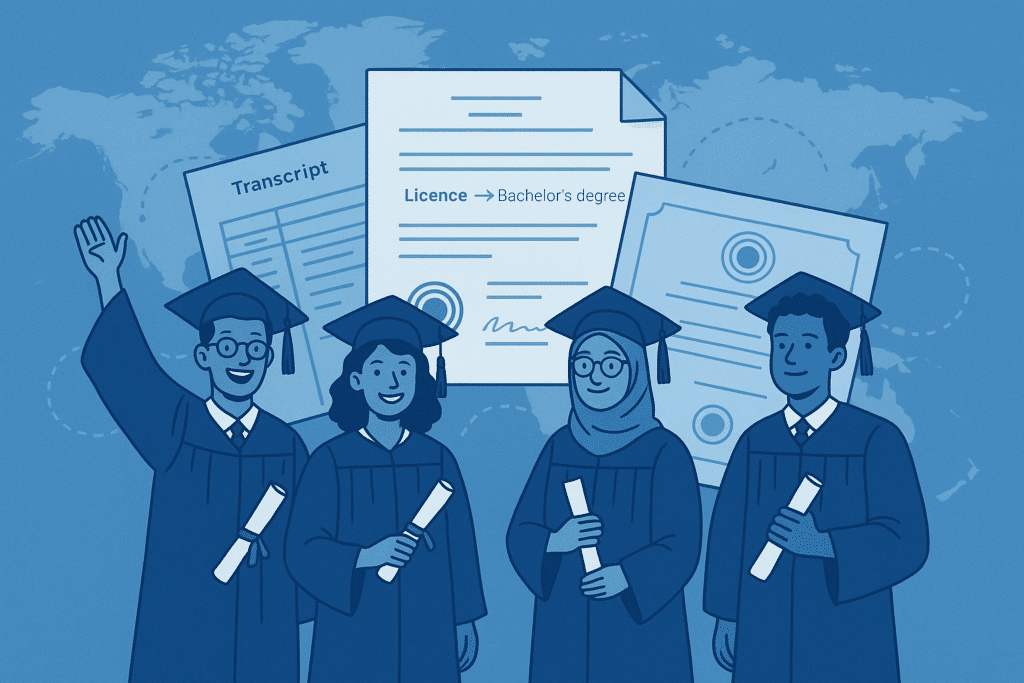
Your official academic and legal documents represent years of your hard work. When you need them for university admissions, professional licensure, or credential evaluations for immigration, there is zero room for error. A single mistake in a translation can delay your application, derail your career plans, or even lead to a rejected petition. We understand what’s at stake. That’s why our approach to document translation goes beyond just words. We follow a strict set of best practices to ensure every credential translation is handled with the accuracy and integrity your future depends on.
Why Certified Human Translators Outperform AI in Credential Translation
At IEE, we work exclusively with highly qualified professional human translators through our certified translation services who are native speakers and subject-matter experts. Each translator specializes in academic and legal documents and possesses in-depth knowledge of global education systems, grading structures, and institutional terminology.
For example, a high school transcript from Brazil might list “Ensino Médio” coursework, while a French university diploma may refer to a “Licence” or “Maîtrise”, terms that don’t have direct English equivalents. Our translators know how to contextualize and accurately render such terminology without losing meaning or misrepresenting qualifications.
Importantly, we never use machine translation tools or AI-generated content. While such tools can speed up general translation, they often miss cultural and technical nuances, leading to potential misinterpretations. Consider a course titled “Formación Cívica y Ética” from Mexico, it might be incorrectly rendered by AI as “Civic Formation,” overlooking the broader implications related to ethics and citizenship education that evaluators need to understand. These are the types of distinctions only experienced human translators can make with confidence.
The Landscape of Modern Document Translation
It’s easy to see the appeal of instant translation tools. When you need to understand a document in another language, platforms powered by artificial intelligence seem like a quick and simple solution. They’ve become incredibly accessible, and for casual use—like translating a restaurant menu or a friendly email—they can be quite effective. However, when it comes to official documents like academic transcripts, diplomas, or legal paperwork, the stakes are much higher. The convenience of AI often comes with hidden risks and limitations that aren’t immediately obvious. Understanding the differences between free automated tools and professional, certified translation services is key to making the right choice for your specific needs, ensuring your documents are accepted without issue.
Understanding Free and AI-Powered Translation Tools
Free and AI-powered translation tools have become a go-to for quick, on-the-fly language conversion. These platforms use complex algorithms to analyze text and provide an immediate translation, often within seconds. While their speed is a major advantage, it’s important to remember that they are machines processing data, not linguists understanding context. They are best suited for informal communication or getting the general meaning of a document where precision is not critical. For any official purpose, relying solely on these tools can be a gamble, as they lack the nuance and certification required by most institutions.
Popular Platforms and How They Work
You’ve likely used or heard of platforms like Google Translate, Canva, or DeepL. These document translators are designed to convert text from files like PDFs and Word documents into another language while attempting to preserve the original formatting. They work by scanning the document, identifying the text, and running it through vast databases of language patterns to generate a translation. The goal is to deliver a file that looks just like the original but with the text in a new language, making them useful for understanding the layout and content of business presentations or simple articles where the exact wording isn’t critical.
Key Features of AI Translators
The main draw of AI translators is their efficiency. They offer incredible speed and can handle large volumes of text in a short amount of time, making them excellent for common business documents. A key feature of modern tools is their ability to maintain the original layout, keeping tables, images, and text in their proper places. This is a significant improvement over older copy-and-paste methods. However, their accuracy can vary, especially with specialized terminology found in academic or legal fields. While they are constantly improving, they still can’t replicate the contextual understanding and cultural awareness of a human expert.
Supported File Formats and Common Limitations
While AI tools are versatile, they aren’t without their boundaries. Most platforms can handle a standard set of file types, but the “free” label often comes with strings attached. These limitations can become significant roadblocks when you’re dealing with lengthy or complex official documents. Understanding these constraints is crucial before you upload your important files, as you might find the tool is unable to process your document correctly or that the quality of the translation is compromised, potentially causing delays in your application process.
File Types You Can Translate
Most AI-powered translation platforms are built to handle the most common file formats used in academic and professional settings. You can typically upload files such as PDFs, Microsoft Word documents (.docx), Excel spreadsheets (.xlsx), and PowerPoint presentations (.pptx). Some services also support plain text files (.txt). This broad compatibility makes it easy to get a quick translation for many types of documents. However, the success of the translation often depends on the quality of the original file; clear, editable text will always yield better results than a scanned, low-resolution image.
The Hidden Costs and Caps of Free Services
The biggest catch with free translation services is their limitations. Many free versions impose caps on the number of pages you can translate or the total file size you can upload. This can be a major issue if you have a multi-page transcript or a large portfolio. Furthermore, their accuracy often drops when dealing with complex, non-editable scans or documents with intricate formatting. For official purposes, where every detail matters, these limitations can lead to critical errors. This is why a professional translation service is essential for guaranteeing the accuracy and acceptance of your academic and legal documents.
Comparing Translation Pricing Models
When you move beyond free tools, you’ll find a few different pricing structures for translation services. AI-driven platforms often use a “freemium” or subscription model, where you pay for advanced features or higher usage limits. In contrast, professional human translation services typically charge based on the document itself, either per page or per word. This model ensures you are paying for the expertise and certification required for official submissions, which is a fundamentally different value proposition than what automated tools offer.
Freemium and Subscription AI Services
Many AI translation companies, like DeepL, operate on a freemium model. They offer a basic level of service for free, which is often enough for casual users, but gate more powerful features behind a paid subscription. These premium tiers might include unlimited document translations, higher security, or the ability to customize a glossary for consistent terminology. While these subscriptions can be valuable for businesses that need to translate large volumes of internal documents quickly, they still don’t typically provide the certified translations required for immigration, licensure, or university applications.
Professional Per-Page and Per-Word Rates
Professional translation services use a different approach. Companies like RushTranslate offer certified document translation for a flat rate, such as $24.95 per page, with guaranteed turnaround times. Other services might charge per word, often around $0.10 per word. This pricing model reflects the manual work and expertise involved. When you pay for a professional service, you are paying for a human expert to accurately translate your document and a certification that guarantees its authenticity to receiving institutions. This is the standard for official use and why transparent, upfront pricing is a hallmark of a trustworthy credential evaluation and translation agency.
How IEE Preserves Document Format and Context for Accurate Evaluations
Accurate translation is only part of the equation. Preserving the layout and structure of the source document is critical for proper evaluation. Our translators carefully mirror the formatting of original diplomas, transcripts, and academic certificates to allow side-by-side comparison during course-by-course evaluations or credential equivalency assessments. This attention to visual structure helps evaluators locate and interpret grades, credit hours, and course descriptions with precision.
We follow global formatting standards and IEE-specific conventions, including:
- Identifying official seals, emblems, watermarks, and other distinguishing visual features
- Translating all legible content, including marginal notes, stamps, and handwritten annotations
- Using footnotes for translator clarifications (e.g., “The grade ‘5’ corresponds to ‘Excellent’ in the Russian system”)
- Flagging missing or illegible content with appropriate notation (e.g., “[Illegible]”)
- Preserving untranslated official terminology when needed, with contextual notes in brackets
This level of detail becomes especially important when working with documents from countries like China or Iran, where stamps and official remarks often validate academic records and may influence eligibility for immigration or academic credit transfer.
Certified Translations That Meet USCIS, University, and Licensure Standards
Every translation from IEE is delivered as a certified translation, complete with a signed translator declaration, listing the date, credentials, and a clear statement confirming the translation’s completeness and accuracy. We fully comply with ATA (American Translators Association) standards, which are widely accepted by universities, state licensing boards, and U.S. immigration agencies such as USCIS.
Each IEE-certified translation is traceable through a unique reference number and is paired with the original document, making it easy for evaluators. Review the required documents by country to ensure you submit everything needed and institutions to validate authenticity.
Additional Services for Official Documents
Notarization for Extra Verification
Sometimes, a certified translation needs an additional layer of security, and that’s where notarization comes in. A notary public acts as an impartial witness to verify the authenticity of signatures on your documents, which helps prevent fraud and confirms that your paperwork is legally sound. This step is often required for documents used in legal proceedings, for certain types of employment verification, or for specific professional licenses. For many of our clients, notarization provides crucial peace of mind, adding a level of credibility that ensures their important papers will be accepted without question. It’s a straightforward way to protect the integrity of your documents and avoid potential delays in your academic or professional journey.
Apostille for International Recognition
If you need to use your official U.S. documents in another country, you may be asked for an apostille. Think of it as an international form of notarization, designed to simplify the process of cross-border document acceptance. An apostille is a special certificate that authenticates your documents for use in any of the countries that are part of the Hague Convention. It certifies the signature, the capacity of the person who signed the document, and any official seals, so foreign institutions can easily confirm its legitimacy. This is particularly useful for anyone applying to a university abroad or seeking professional licensure in another country, as it streamlines the verification process and ensures a smoother path to acceptance.
Integrated Translation and Evaluation Services for Faster Results
What sets IEE apart is our fully integrated translation and evaluation workflow. Our in-house Translation and Evaluation Teams work closely to ensure that once your document is translated, it’s immediately formatted for review, no further editing, clarification, or reformatting needed. This seamless collaboration eliminates delays and prevents the kinds of common issues that arise when working with multiple third-party providers.
That said, we also respect flexibility. If you already have a certified translation from a reputable, ATA-compliant translator, we are happy to review and accept it, provided it meets our quality and formatting standards
Whether you’re submitting academic transcripts for admission to a graduate program, a foreign degree for licensure as a nurse or teacher, or credentials for an immigration petition, you can trust IEE Language Services to provide accurate, certified translations that meet institutional requirements and uphold your professional goals.
At IEE, we don’t just translate documents, we translate opportunity.
Frequently Asked Questions
Is it really that bad to use a free online tool to translate my academic transcript? For something as important as an academic transcript, using a free AI tool is a significant gamble. While they are useful for getting the general idea of a document, they often fail to capture the specific terminology and cultural context of educational systems. An incorrect translation of a course title or grade could misrepresent your qualifications, leading to delays or even a rejection from the institution you’re applying to. Professional human translation ensures that every detail is conveyed accurately.
What exactly is a “certified translation” and why do institutions require it? A certified translation includes a signed statement from the translator or translation company vouching for the accuracy and completeness of the document. This isn’t just a formality; it’s a guarantee of authenticity. Universities, licensing boards, and government agencies like USCIS require this certification because it confirms that the translation is a faithful and professional rendering of the original document, free from personal bias or error.
I already paid for a translation from another company. Can I use it for my IEE evaluation? Yes, you absolutely can. We are happy to review and accept a translation you’ve already obtained, as long as it meets professional standards. This means it must be a certified translation from a reputable, ATA-compliant provider and follow the proper formatting guidelines. Our goal is to make the process smooth for you, so if your existing translation is accurate and complete, we can proceed with the evaluation.
Why is preserving the original document’s format so important? The layout of your transcript or diploma contains crucial information beyond just the text. The placement of seals, stamps, signatures, and even footnotes provides context that is essential for a proper evaluation. By mirroring the original format, our translators allow evaluators to conduct a side-by-side comparison, which helps them accurately interpret your credentials and verify the document’s authenticity.
My documents are for immigration. Are your translations accepted by USCIS? Yes, our certified translations are prepared to meet the specific requirements of U.S. Citizenship and Immigration Services (USCIS). Each translation comes with the necessary signed declaration of accuracy from the translator, ensuring it complies with the standards required for immigration petitions, visa applications, and other official submissions.
Related Articles
- Certified Document Translation: Why It Matters
- Understanding IEE’s Credential Evaluation Services: Which Report is Right for You?
- What’s the Real Credential Evaluation Cost?
Key Takeaways
- Rely on human experts for high-stakes documents: While AI tools are convenient for casual use, they often fail to capture the specific terminology of academic and legal documents. A professional translator ensures every detail is correct, preventing critical errors in your application.
- A certified translation is non-negotiable for official use: Universities, licensing boards, and government agencies require a formal certification of accuracy. This signed declaration confirms the translation is complete and authentic, a standard that automated tools cannot provide.
- Streamline your application with an all-in-one service: Using a single provider for both translation and evaluation eliminates the back-and-forth between different agencies. This integrated approach prevents formatting errors and significantly speeds up your timeline.
Related Articles
- IEE Language Services: Certified Translations | Evaluation Company & Translation Company
- Immigration Support for Credential Evaluations | IEE
- Frequently Asked Questions & Answers | IEE
- Verification Services for Authenticating Documents | IEE